
Macro Corner
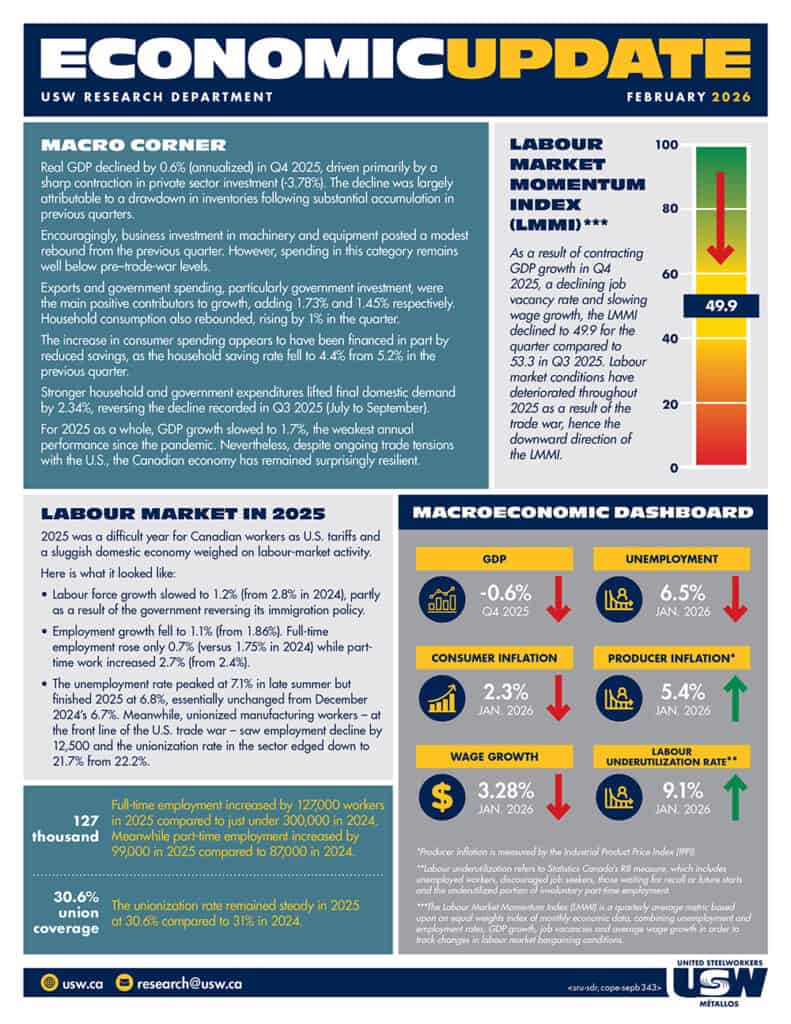
Real GDP declined by 0.6% (annualized) in Q4 2025, driven primarily by a sharp contraction in private sector investment (-3.78%). The decline was largely attributable to a drawdown in inventories following substantial accumulation in previous quarters.
Encouragingly, business investment in machinery and equipment posted a modest rebound from the previous quarter. However, spending in this category remains well below pre–trade-war levels.
Exports and government spending, particularly government investment, were the main positive contributors to growth, adding 1.73% and 1.45% respectively. Household consumption also rebounded, rising by 1% in the quarter.
The increase in consumer spending appears to have been financed in part by reduced savings, as the household saving rate fell to 4.4% from 5.2% in the previous quarter.
Stronger household and government expenditures lifted final domestic demand by 2.34%, reversing the decline recorded in Q3 2025 (July to September).
For 2025 as a whole, GDP growth slowed to 1.7%, the weakest annual performance since the pandemic. Nevertheless, despite ongoing trade tensions with the U.S., the Canadian economy has remained surprisingly resilient.
Labour Market Momentum Index (LMMI)
As a result of contracting GDP growth in Q4 2025, a declining job vacancy rate and slowing wage growth, the LMMI declined to 49.9 for the quarter compared to 53.3 in Q3 2025. Labour market conditions have deteriorated throughout 2025 as a result of the trade war, hence the downward direction of the LMMI.
Labour Market in 2025
2025 was a difficult year for Canadian workers as U.S. tariffs and a sluggish domestic economy weighed on labour-market activity.
Here is what it looked like:
- Labour force growth slowed to 1.2% (from 2.8% in 2024), partly as a result of the government reversing its immigration policy.
- Employment growth fell to 1.1% (from 1.86%). Full-time employment rose only 0.7% (versus 1.75% in 2024) while part-time work increased 2.7% (from 2.4%).
- The unemployment rate peaked at 7.1% in late summer but finished 2025 at 6.8%, essentially unchanged from December 2024’s 6.7%. Meanwhile, unionized manufacturing workers – at the front line of the U.S. trade war – saw employment decline by 12,500 and the unionization rate in the sector edged down to 21.7% from 22.2%.
Full-time employment increased by 127,000 workers in 2025 compared to just under 300,000 in 2024. Meanwhile part-time employment increased by 99,000 in 2025 compared to 87,000 in 2024.
The unionization rate remained steady in 2025at 30.6% compared to 31% in 2024.