
MACRO CORNER
GDP growth rose to 2% (annualized) in February 2026, up from 1.7% in January. * Manufacturing output rebounded in February, increasing by 1.8%, while manufacturing capacity utilization improved to 77.1%, up from 75.4%
in January.
After a difficult start to the year, steel and auto production rebounded in February, rising by 10.5% and 9.8%, respectively. Aluminum production also continued its strong start to 2026, with output expanding by 4.1% in February, following a 5.9% increase in January. The mining sector, excluding oil sands, likewise maintained solid growth, with output increasing by 1.2% in February after a 1% gain in January.
In contrast, forestry and wood products manufacturing output continued to contract. Forestry and logging output has declined consistently since September 2025, with February 2026 marking the sixth consecutive month of contraction, down 1.2%. Wood products manufacturing output also fell by 1.5% in February, its third straight monthly decline. In addition, sawmill output decreased by 5% in February compared to January, marking its fifth consecutive month of contraction.
*Statistics Canada Monthly GDP by Industry figures for January 2026 were revised upward
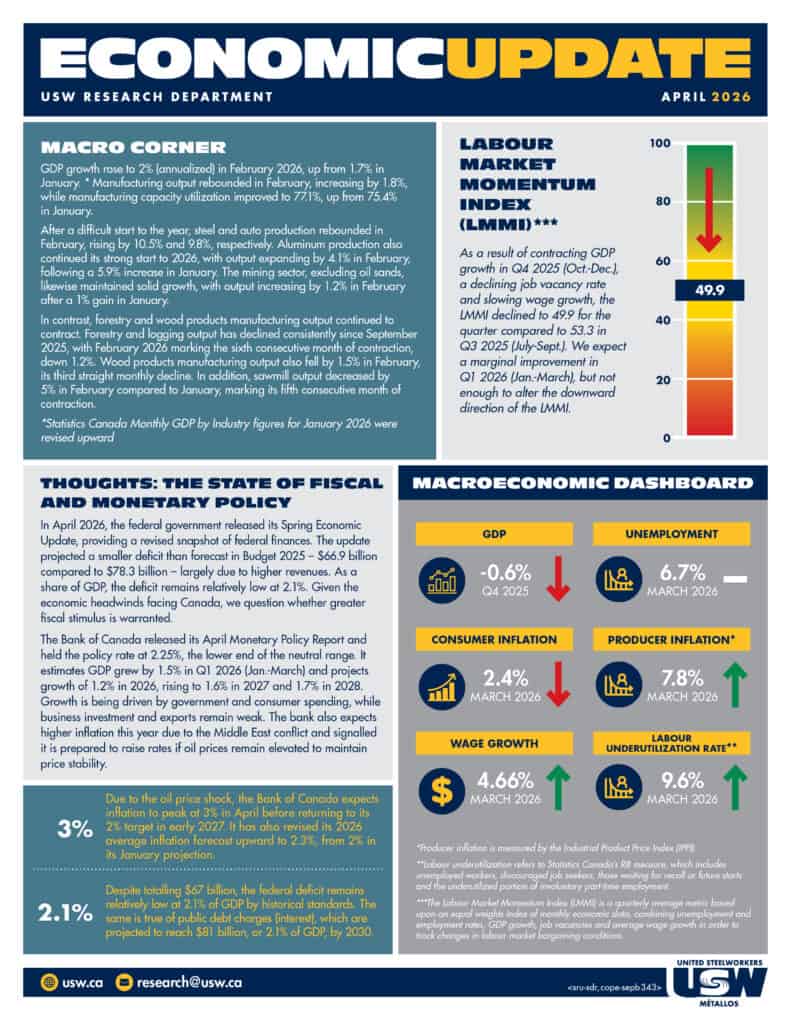
LABOUR MARKET MOMENTUM INDEX (LMMI) ***
As a result of contracting GDP growth in Q4 2025 (Oct.-Dec.), a declining job vacancy rate and slowing wage growth, the LMMI declined to 49.9 for the quarter compared to 53.3 in Q3 2025 (July-Sept.). We expect a marginal improvement in Q1 2026 (Jan.-March), but not enough to alter the downward direction of the LMMI.
THOUGHTS: THE STATE OF FISCAL AND MONETARY POLICY
In April 2026, the federal government released its Spring Economic Update, providing a revised snapshot of federal finances. The update projected a smaller deficit than forecast in Budget 2025 – $66.9 billioncompared to $78.3 billion – largely due to higher revenues. As a share of GDP, the deficit remains relatively low at 2.1%. Given the economic headwinds facing Canada, we question whether greater fiscal stimulus is warranted.
The Bank of Canada released its April Monetary Policy Report and held the policy rate at 2.25%, the lower end of the neutral range. It estimates GDP grew by 1.5% in Q1 2026 (Jan.-March) and projects growth of 1.2% in 2026, rising to 1.6% in 2027 and 1.7% in 2028. Growth is being driven by government and consumer spending, while business investment and exports remain weak. The bank also expects higher inflation this year due to the Middle East conflict and signalled it is prepared to raise rates if oil prices remain elevated to maintain price stability.
DownloadRequest this file in a different format