
MACRO CORNER
GDP returned to growth in April 2026, increasing by 0.55% compared with the previous month. After a month of contraction, manufacturing output also rebounded, rising 0.62%.
Wood product manufacturing returned to positive growth, increasing by 2.6%, led by Canadian sawmills, where output rose by 4.3%, ending six consecutive months of declining production. Iron and steel mills also returned to positive growth, with output increasing by 6.1% after three months of significant declines, while aluminum production fell by 3.1%. Meanwhile, motor vehicle and parts manufacturing output increased by 1.4%, marking its third consecutive month of growth.
Although manufacturing capacity utilization edged down to 80.6% in April from 81.8% in March, it remains above the previous 12-month average of 78%. Manufacturing sales and new orders continued to strengthen, rising by 4.2% and 2.1%, respectively, in April – the third consecutive month of growth for both indicators. Statistics Canada’s advance estimates suggest manufacturing sales increased by a further 1.1% in May.
The ratio of finished goods inventories to sales – a key indicator of unplanned inventory accumulation – fell to 0.50 in April, its lowest level in the previous 12 months.
In early June 2026, the Bank of Canada maintained the overnight policy interest rate at 2.25%, citing ongoing concerns about weak economic growth and supply-side pressure on energy prices resulting from the continuing conflict in Iran.
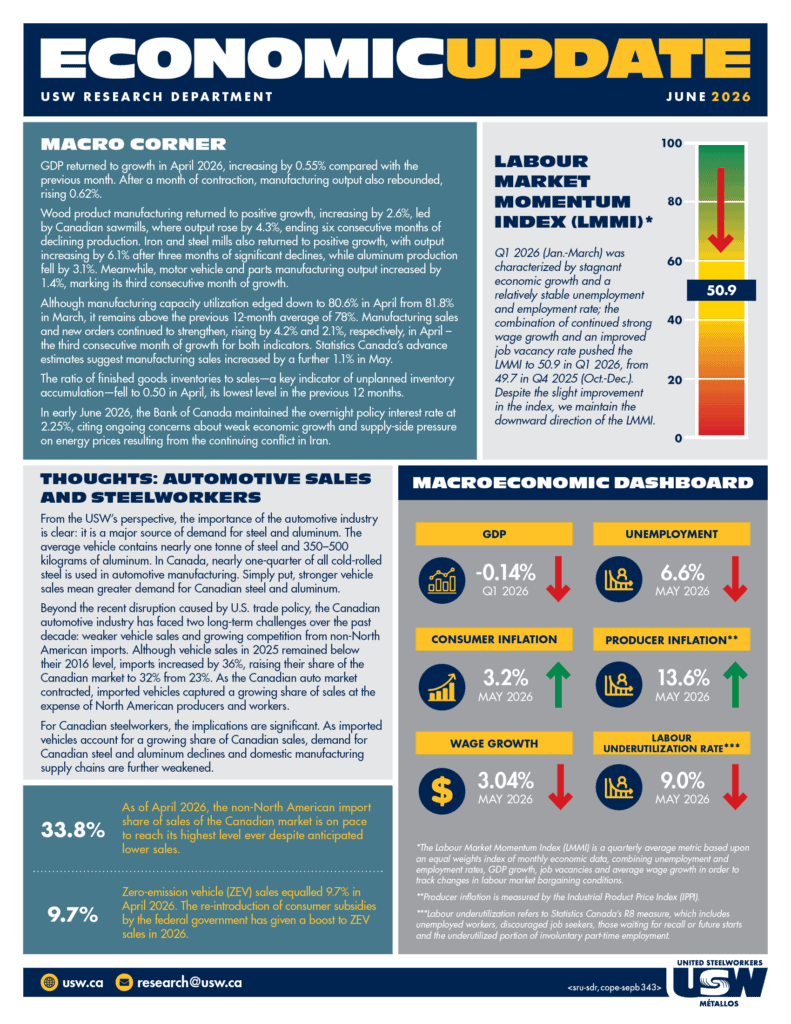
LABOUR MARKET MOMENTUM INDEX (LMMI)
Q1 2026 (Jan.-March) was characterized by stagnant economic growth and a
relatively stable unemployment and employment rate; the combination of continued strong wage growth and an improved job vacancy rate pushed the LMMI to 50.9 in Q1 2026, from 49.7 in Q4 2025 (Oct.-Dec.). Despite the slight improvement in the index, we maintain the downward direction of the LMMI
THOUGHTS: AUTOMOTIVE SALES AND STEELWORKERS
From the USW’s perspective, the importance of the automotive industry is clear: it is a major source of demand for steel and aluminum. The average vehicle contains nearly one tonne of steel and 350–500 kilograms of aluminum. In Canada, nearly one-quarter of all cold-rolled steel is used in automotive manufacturing. Simply put, stronger vehicle sales mean greater demand for Canadian steel and aluminum.
Beyond the recent disruption caused by U.S. trade policy, the Canadian automotive industry has faced two long-term challenges over the past decade: weaker vehicle sales and growing competition from non-North American imports. Although vehicle sales in 2025 remained below their 2016 level, imports increased by 36%, raising their share of the Canadian market to 32% from 23%. As the Canadian auto market contracted, imported vehicles captured a growing share of sales at the expense of North American producers and workers.
For Canadian steelworkers, the implications are significant. As imported vehicles account for a growing share of Canadian sales, demand for Canadian steel and aluminum declines and domestic manufacturing supply chains are further weakened.
DownloadRequest this file in a different format