
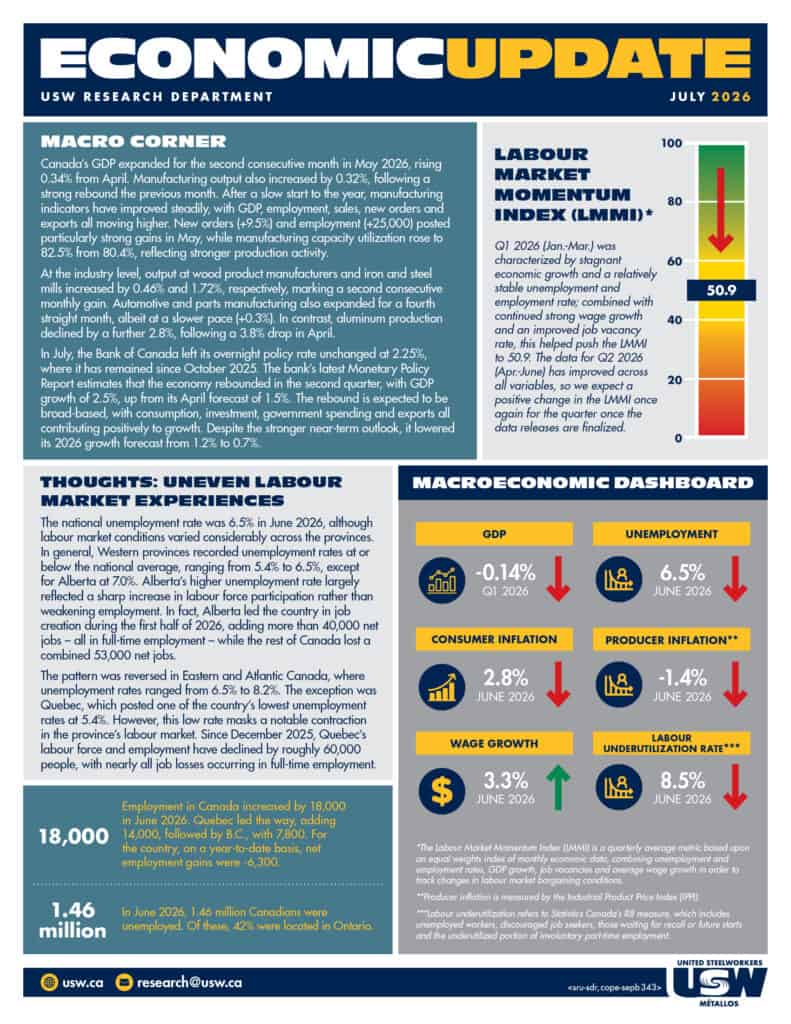
MACRO CORNER
Canada’s GDP expanded for the second consecutive month in May 2026, rising 0.34% from April. Manufacturing output also increased by 0.32%, following a strong rebound the previous month. After a slow start to the year, manufacturing indicators have improved steadily, with GDP, employment, sales, new orders and exports all moving higher. New orders (+9.5%) and employment (+25,000) posted particularly strong gains in May, while manufacturing capacity utilization rose to 82.5% from 80.4%, reflecting stronger production activity.
At the industry level, output at wood product manufacturers and iron and steel mills increased by 0.46% and 1.72%, respectively, marking a second consecutive monthly gain. Automotive and parts manufacturing also expanded for a fourth straight month, albeit at a slower pace (+0.3%). In contrast, aluminum production declined by a further 2.8%, following a 3.8% drop in April.
In July, the Bank of Canada left its overnight policy rate unchanged at 2.25%, where it has remained since October 2025. The bank’s latest Monetary Policy Report estimates that the economy rebounded in the second quarter, with GDP growth of 2.5%, up from its April forecast of 1.5%. The rebound is expected to be broad-based, with consumption, investment, government spending and exports all contributing positively to growth. Despite the stronger near-term outlook, it lowered its 2026 growth forecast from 1.2% to 0.7%.
LABOUR MARKET MOMENTUM INDEX (LMMI) *
Q1 2026 (Jan.-Mar.) was characterized by stagnant economic growth and a relatively stable unemployment and employment rate; combined with continued strong wage growth and an improved job vacancy rate, this helped push the LMMI to 50.9. The data for Q2 2026 (Apr.-June) has improved across all variables, so we expect a positive change in the LMMI once again for the quarter once the data releases are finalized.
THOUGHTS: UNEVEN LABOUR MARKET EXPERIENCES
The national unemployment rate was 6.5% in June 2026, although labour market conditions varied considerably across the provinces. In general, Western provinces recorded unemployment rates at or below the national average, ranging from 5.4% to 6.5%, except for Alberta at 7.0%. Alberta’s higher unemployment rate largely reflected a sharp increase in labour force participation rather than weakening employment. In fact, Alberta led the country in job creation during the first half of 2026, adding more than 40,000 net jobs – all in full-time employment – while the rest of Canada lost a combined 53,000 net jobs.
The pattern was reversed in Eastern and Atlantic Canada, where unemployment rates ranged from 6.5% to 8.2%. The exception was Quebec, which posted one of the country’s lowest unemployment rates at 5.4%. However, this low rate masks a notable contraction in the province’s labour market. Since December 2025, Quebec’s labour force and employment have declined by roughly 60,000 people, with nearly all job losses occurring in full-time employment.
DownloadRequest this file in a different format