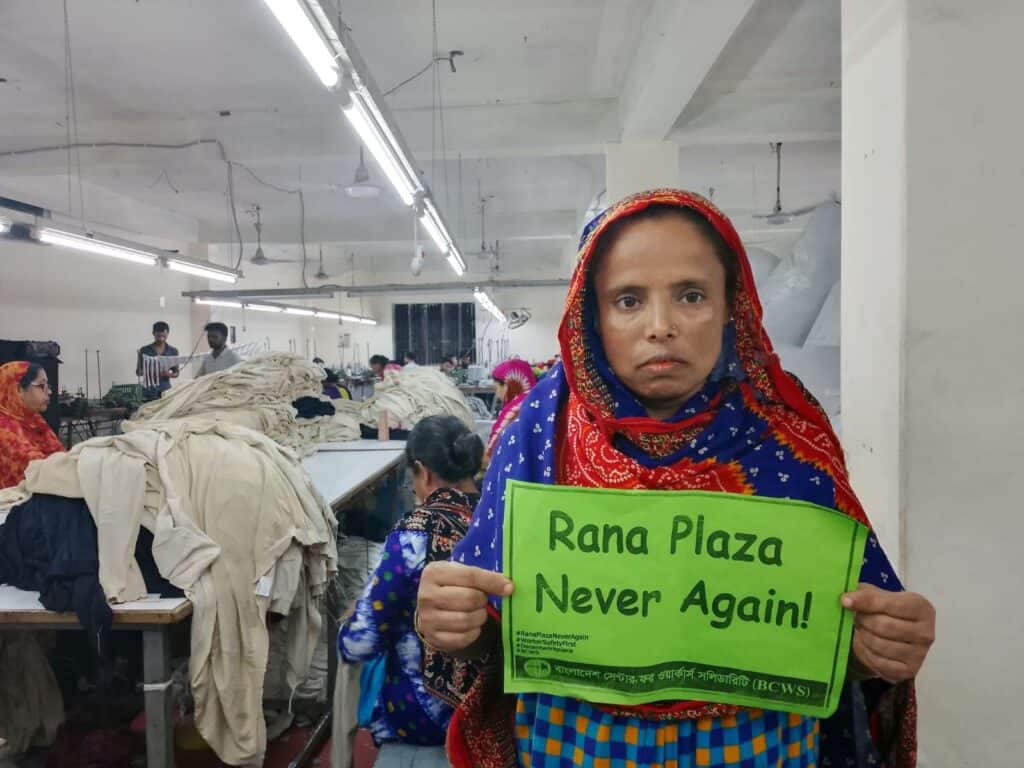
(Photo courtesy of Bangladesh Center for Workers Solidarity)
Since 2013, when the Rana Plaza factory collapsed in Bangladesh, Canada’s unions have marked the tragic April 24th anniversary by bringing attention to the ongoing unacceptable working conditions of Bangladeshi workers in the ready-made garment industry.
The Rana Plaza industrial disaster, which killed 1,134 workers and injured thousands more, shone a spotlight on the lack of accountability of transnational corporations in providing safe and decent conditions for workers in source factories across their global supply chains.
It inspired a global movement to demand that corporations take responsibility and provide safe workplaces, pay fair wages, allow workers to organize and join democratic unions and to bargain collectively.
There have been some improvements to working conditions and to the development of national and global mechanisms to ensure the advancement of rights and protections. With global support, there were quick and effective responses to assess and address structural and safety conditions in thousands of factories following the Rana Plaza collapse, but today Bangladeshi workers are still languishing in conditions of poverty wages and unfair workplace conditions.
Unions in Canada have worked on many fronts to ensure better working conditions for garment sector workers, including with partners in Bangladesh and with global and national allies. We have advocated for corporate accountability legislation and for mechanisms to bring complaints against Canadian companies for human and labour rights violations and environmental abuse in their overseas operations.
In 2018, unions celebrated the launch of the Canadian Ombudsperson for Responsible Enterprise (CORE), an office we had long called for to provide a pathway for people and communities affected negatively by the actions of Canadian companies to seek justice. Unfortunately, this office was never given what it needed to function as a powerful mechanism to address human and labour rights violations in the operations of Canadian companies abroad. We have also long advocated for mandatory human rights due diligence legislation that requires Canadian companies to prevent and address harms to people and the environment throughout their supply chain.
Since 2016, workers have been loudly calling for global supply chain instruments at the International Labour Organization (ILO), where governments must comply with ratified labour standards in law and practice. We welcome the ILO’s 2024 guidance on living wages, which establishes global principles for defining, calculating and implementing living wages across diverse economic contexts. Trade unions continue to hold the Bangladeshi government to account at the ILO for not registering free and independent unions, for the ongoing harassment and violence against trade union leaders and activists, for the detention of workers trying to form unions, and for the failure to pay fair wages and provide employment injury insurance.
Twelve years after Rana Plaza, Canada’s unions remain committed to supporting Bangladeshi workers and their demands for the rights to freedom of association and collective bargaining, the basics to allow workers to be heard, to be safe, and to be active social partners in improving living and working conditions for everyone.
On the eve of the Federal elections, we call on the incoming administration to do all in its power to hold Canadian companies accountable and to ensure the respect of human and labour rights and the environment in their overseas operations, including:
- To equip and empower the CORE with the investigatory powers, resources, and independence from government needed to effectively serve impacted people;
- To adopt mandatory human rights due diligence legislation that requires companies to prevent the risk of harm to people and the environment throughout their supply chains and to put in place adequate procedures to minimize the risk, remedy any existing harm, and do everything in their power to prevent future harm; and
- To support a United Nations Binding Treaty on Business and Human Rights to regulate the activities of transnational corporations and other business enterprises in international human rights law.
Original statement on Canadian Labour Congress website.
Share on Facebook