
MACRO CORNER
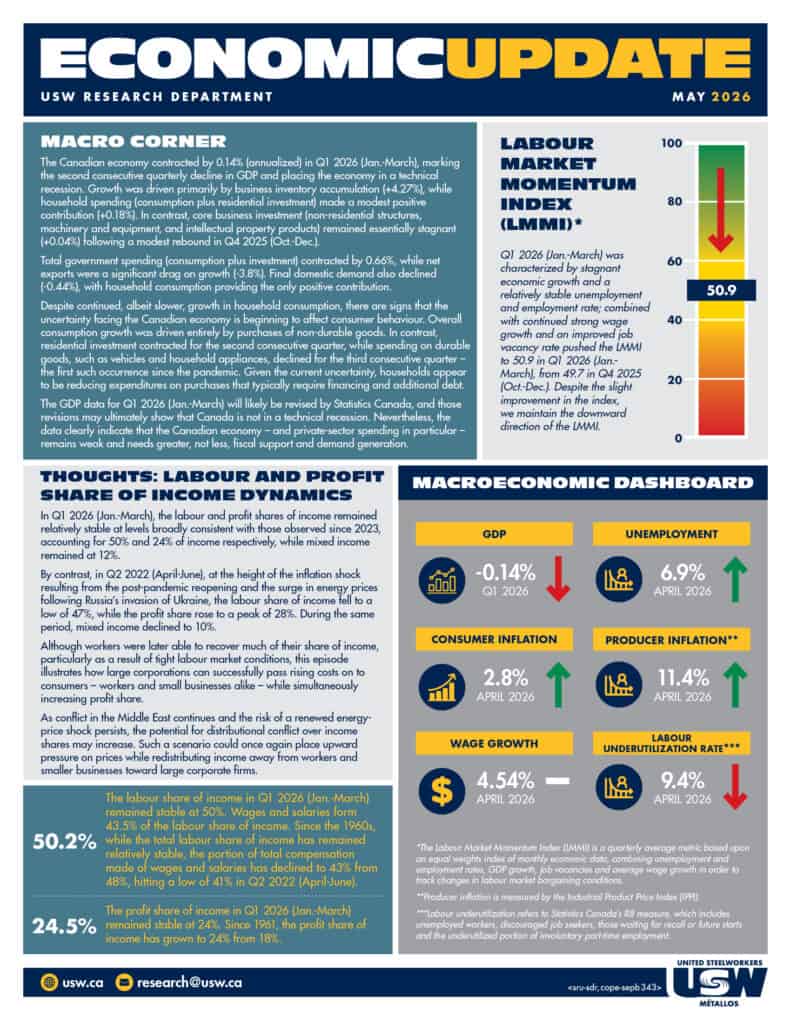
The Canadian economy contracted by 0.14% (annualized) in Q1 2026 (Jan.-March), marking the second consecutive quarterly decline in GDP and placing the economy in a technical recession. Growth was driven primarily by business inventory accumulation (+4.27%), while household spending (consumption plus residential investment) made a modest positive contribution (+0.18%). In contrast, core business investment (non-residential structures, machinery and equipment, and intellectual property products) remained essentially stagnant (+0.04%) following a modest rebound in Q4 2025 (Oct.-Dec.).
Total government spending (consumption plus investment) contracted by 0.66%, while net exports were a significant drag on growth (-3.8%). Final domestic demand also declined (-0.44%), with household consumption providing the only positive contribution.
Despite continued, albeit slower, growth in household consumption, there are signs that the uncertainty facing the Canadian economy is beginning to affect consumer behaviour. Overall consumption growth was driven entirely by purchases of non-durable goods. In contrast, residential investment contracted for the second consecutive quarter, while spending on durable goods, such as vehicles and household appliances, declined for the third consecutive quarter – the first such occurrence since the pandemic. Given the current uncertainty, households appear to be reducing expenditures on purchases that typically require financing and additional debt.
The GDP data for Q1 2026 (Jan.-March) will likely be revised by Statistics Canada, and those revisions may ultimately show that Canada is not in a technical recession. Nevertheless, the data clearly indicate that the Canadian economy – and private-sector spending in particular – remains weak and needs greater, not less, fiscal support and demand generation.
LABOUR MARKET MOMENTUM INDEX (LMMI) *
Q1 2026 (Jan.-March) was characterized by stagnant economic growth and a relatively stable unemployment and employment rate; combined with continued strong wage growth and an improved job vacancy rate pushed the LMMI to 50.9 in Q1 2026 (Jan.-March), from 49.7 in Q4 2025 (Oct.-Dec.). Despite the slight improvement in the index, we maintain the downward direction of the LMMI.
THOUGHTS: LABOUR AND PROFIT SHARE OF INCOME DYNAMICS
In Q1 2026 (Jan.-March), the labour and profit shares of income remained relatively stable at levels broadly consistent with those observed since 2023, accounting for 50% and 24% of income respectively, while mixed income remained at 12%.
By contrast, in Q2 2022 (April-June), at the height of the inflation shock resulting from the post-pandemic reopening and the surge in energy prices following Russia’s invasion of Ukraine, the labour share of income fell to a low of 47%, while the profit share rose to a peak of 28%. During the same period, mixed income declined to 10%.
Although workers were later able to recover much of their share of income, particularly as a result of tight labour market conditions, this episode illustrates how large corporations can successfully pass rising costs on to consumers – workers and small businesses alike – while simultaneously increasing profit share.
As conflict in the Middle East continues and the risk of a renewed energy price shock persists, the potential for distributional conflict over income shares may increase. Such a scenario could once again place upward pressure on prices while redistributing income away from workers and smaller businesses toward large corporate firms.
DownloadRequest this file in a different format