
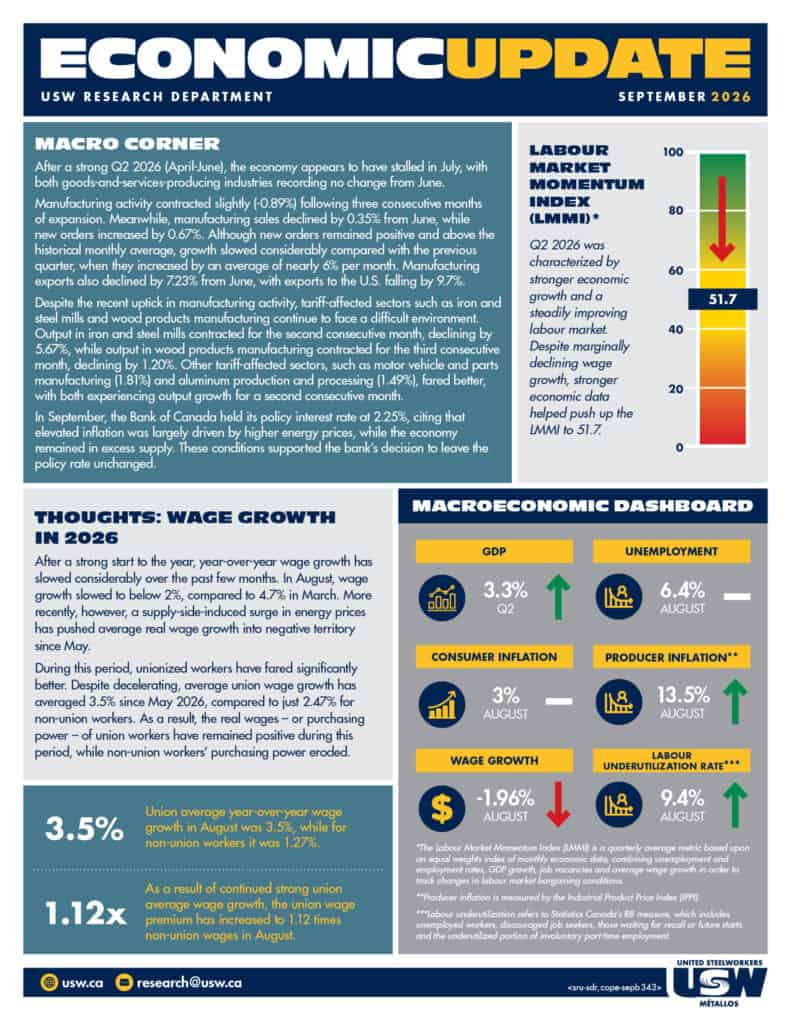
MACRO CORNER
After a strong Q2 2026 (April-June), the economy appears to have stalled in July, with both goods-and-services-producing industries recording no change from June.
Manufacturing activity contracted slightly (-0.89%) following three consecutive months of expansion. Meanwhile, manufacturing sales declined by 0.35% from June, while new orders increased by 0.67%. Although new orders remained positive and above the historical monthly average, growth slowed considerably compared with the previous quarter, when they increased by an average of nearly 6% per month. Manufacturing exports also declined by 7.23% from June, with exports to the U.S. falling by 9.7%.
Despite the recent uptick in manufacturing activity, tariff-affected sectors such as iron and steel mills and wood products manufacturing continue to face a difficult environment. Output in iron and steel mills contracted for the second consecutive month, declining by 5.67%, while output in wood products manufacturing contracted for the third consecutive month, declining by 1.20%. Other tariff-affected sectors, such as motor vehicle and parts manufacturing (1.81%) and aluminum production and processing (1.49%), fared better,
with both experiencing output growth for a second consecutive month.
In September, the Bank of Canada held its policy interest rate at 2.25%, citing that elevated inflation was largely driven by higher energy prices, while the economy remained in excess supply. These conditions supported the bank’s decision to leave the policy rate unchanged.
LABOUR MARKET MOMENTUM INDEX (LMMI) *
Q2 2026 was characterized by stronger economic growth and a steadily improving labour market. Despite marginally declining wage growth, stronger economic data helped push up the LMMI to 51.7
THOUGHTS: WAGE GROWTH IN 2026
After a strong start to the year, year-over-year wage growth has slowed considerably over the past few months. In August, wage growth slowed to below 2%, compared to 4.7% in March. More recently, however, a supply-side-induced surge in energy prices has pushed average real wage growth into negative territory since May.
During this period, unionized workers have fared significantly better. Despite decelerating, average union wage growth has averaged 3.5% since May 2026, compared to just 2.47% for non-union workers. As a result, the real wages – or purchasing power – of union workers have remained positive during this period, while non-union workers’ purchasing power eroded.
Request this file in a different format