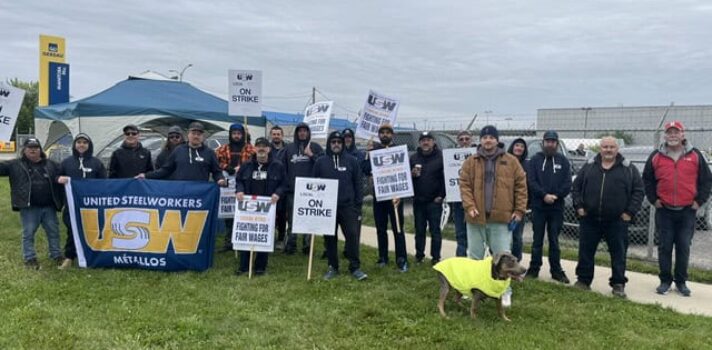
The following statement was released jointly today by Canada’s two largest industrial unions, Unifor and the United Steelworkers:
U.S. sector-based tariffs (“section 232 tariffs”) have hit Canadian manufacturing workers and businesses hard, impacting families and entire communities. Many Canadian steel mills, auto plants, wood product facilities and aluminum fabricators have slowed or shuttered production, leaving thousands of skilled workers unemployed.
How Canada responds to this moment – with the pending CUSMA review and further rounds of U.S. trade aggression looming – will define our economy for generations.
Canada’s economy is becoming worryingly reliant on raw resource exports, and less on value added production. The tariff shock of 2025 has reinforced the lesson: without strong industry, Canada’s economic sovereignty is fragile.
The White House has signaled that more hardship is coming. New tariffs aimed at aircraft, factory machinery, critical minerals, pharmaceuticals, and other industrial products threaten to widen the economic blast radius in 2026. For Canadian workers and their families, that likely means another year of bad news, unless government negotiators can strike a fair, and durable resolution to this lingering trade dispute.
Safeguarding our industrial economy is no longer just an economic imperative; it is a national one. That means acting decisively on several fronts.
First, Canada needs a serious, modern industrial strategy. One that aligns trade policy, public procurement, investment incentives, and climate goals to protect and expand domestic manufacturing. Strategic sectors (including steel, aluminum, autos, aerospace and defence, clean energy technologies, critical minerals, and forestry) must be supported not with ad-hoc government contributions, but with long-term policy certainty, that rewards investment, innovation, productivity, and expanded capacity.
Second, government must flex Canada’s market muscle. The Canadian market is an important one, especially to the United States. Canada cannot simply be the resource warehouse for the United States or the rest of the world. Our resource wealth is our greatest strength and we need to leverage it. Maximizing this natural wealth means demanding further value-added production – in refining, processing and primary manufacturing. Put simply, we need to use our natural resources to grow, not shrink, our industrial base.
Third, governments should use their purchasing power to strengthen domestic supply chains. “Buy Canadian” policies, applied smartly and transparently, can help stabilize demand, support local producers, and keep public dollars circulating at home – especially in infrastructure, transit, defence, and energy projects. The Carney government has taken good first steps and must continue to expand Canada’s local content strategy.
Finally, Canada must leverage its strengths while addressing other external threats. That includes diversifying export markets and enforcing trade rules against unfair practices – particularly from China. Standing up to one source of economic coercion while ignoring another will not protect our industrial economy.
The choices made in the next year – on CUSMA, on industrial policy, and on how forcefully we defend workers and industries – will shape whether Canada remains a country that builds, innovates, and provides good jobs, or one that slowly surrenders its industrial backbone. It will not be enough for government negotiators to lead the charge: as Canada enters CUSMA negotiations and develops industrial plans, unions must be included at sectoral tables to ensure strong outcomes not only for industry, but for workers. This next year will be the most consequential in Canada’s history, and securing a strong, future-ready economy means safeguarding the industrial sector, that has long been at its core.
Marty Warren
National Director for Canada
United Steelworkers
Lana Payne
National President
Unifor
Share on Facebook