By The Canadian Centre for Policy Alternatives (CCPA)
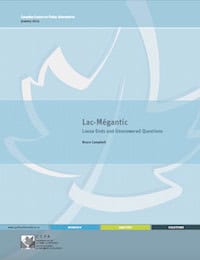
OTTAWA – Investigations to date into the Lac-Mégantic disaster – the most comprehensive of which is the August 2014 Transportation Safety Board (TSB) report – leave too many unanswered questions, says a study released by the Canadian Centre for Policy Alternatives (CCPA).
The study, by CCPA Executive Director Bruce Campbell, points to the discrepancy between the withering remarks on regulatory breakdown by the outgoing TSB chair, and the report’s more muted conclusions as to cause and contributing factors of the TSB report itself. Most glaringly, Transport Canada’s decision to allow MMA to operate its massive oil trains with a single crew member which – despite evidence in the body of the TSB report itself – was not listed as a cause and contributing factor to the accident.
“The federal government would like the TSB report to be the final word on Lac-Mégantic but there are too many unanswered questions, too many loose ends,” says Campbell. “The worst rail disaster in modern Canadian history warrants nothing less than an independent judicial commission or inquiry.”
The study, the third in a series on Lac-Mégantic, identifies numerous regulatory failures, the responsibility for which ultimately rests at the very top. However, government and industry spokespersons have denied any responsibility for the accident alleging that culpability rests solely with the three MMA employees at the bottom of the accountability pyramid.
The study asks why Transport Canada got off relatively lightly and raises questions about the about possible political pressure and interference; or alternatively whether the board simply did not want to antagonize the government-a consequence of the chill effect that has become the new normal in government-public service relations.
With new pipeline projects-east, west, and south-stalled by political and legal obstacles and social resistance, transportation of oil by rail is emerging as a last resort option. An independent inquiry is a necessary precondition to obtaining the social licence from Canadians to support this development.
“The people of Lac-Mégantic, and indeed all Canadians, need assurance that the rail safety measures implemented over the last 18 months are sufficient to prevent another such tragedy. They need to know that, over time, there will be no backsliding, no watering down or circumvention of Transport Canada’s public safety mandate,” says Campbell.
Related Articles
Loose Ends and Unanswered Questions
OTTAWA—Investigations to date into the Lac-Mégantic disaster—the most comprehensive of which is the August 2014 Transportation Safety Board (TSB) report—leave too many unanswered questions, says a study released today by the Canadian Centre for Policy Alternatives (CCPA).
The study, by CCPA Executive Director Bruce Campbell, points to the discrepancy between the withering remarks on regulatory breakdown by the outgoing TSB chair, and the report’s more muted conclusions as to cause and contributing factors of the TSB report itself. Most glaringly, Transport Canada’s decision to allow MMA to operate its massive oil trains with a single crew member which—despite evidence in the body of the TSB report itself—was not listed as a cause and contributing factor to the accident.
“The federal government would like the TSB report to be the final word on Lac-Mégantic but there are too many unanswered questions, too many loose ends,” says Campbell. “The worst rail disaster in modern Canadian history warrants nothing less than an independent judicial commission or inquiry.”
The study, the third in a series on Lac-Mégantic, identifies numerous regulatory failures, the responsibility for which ultimately rests at the very top. However, government and industry spokespersons have denied any responsibility for the accident alleging that culpability rests solely with the three MMA employees at the bottom of the accountability pyramid.
The study asks why Transport Canada got off relatively lightly and raises questions about the about possible political pressure and interference; or alternatively whether the board simply did not want to antagonize the government—a consequence of the chill effect that has become the new normal in government-public service relations.
With new pipeline projects—east, west, and south—stalled by political and legal obstacles and social resistance, transportation of oil by rail is emerging as a last resort option. An independent inquiry is a necessary precondition to obtaining the social licence from Canadians to support this development.
“The people of Lac-Mégantic, and indeed all Canadians, need assurance that the rail safety measures implemented over the last 18 months are sufficient to prevent another such tragedy. They need to know that, over time, there will be no backsliding, no watering down or circumvention of Transport Canada’s public safety mandate,” says Campbell.
– See more at: https://www.policyalternatives.ca/newsroom/news-releases/study-calls-independent-inquiry-lac-m%C3%A9gantic-disaster#sthash.pChGgWin.dpuf
Download
Share on Facebook