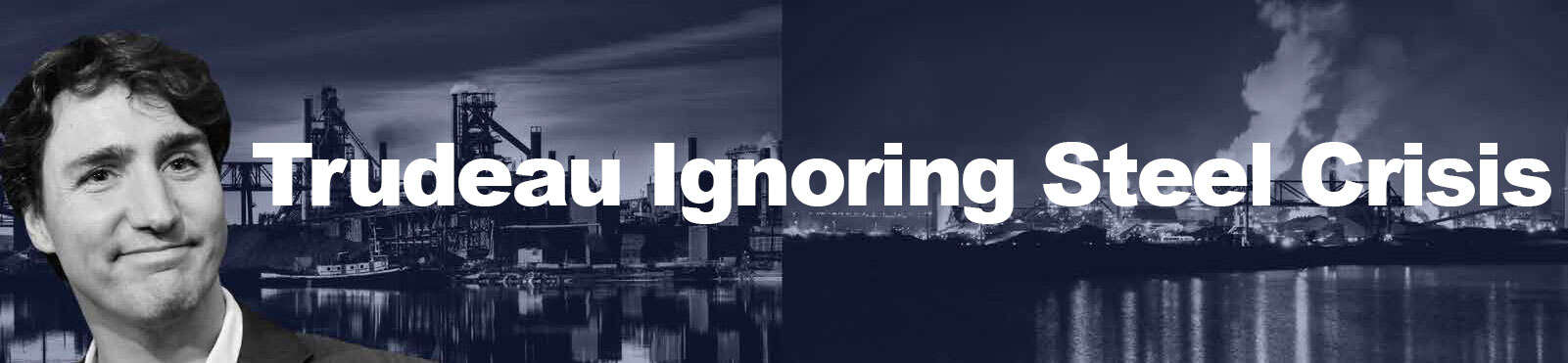
Photo of Essar Steel Algoma: Billy_Wilson on Flickr used under CC BY-NC 2.0; Photo of Prime Minister Justin Trudeau: justintrudeau on Flickr used under CC BY-NC-SA 2.0.
From workers, pensioners and unions, to industry leaders, politicians representing steel communities and even in the news media, a nationwide consensus has emerged calling for the federal Liberal government to address Canada’s steel industry crisis.
USW members are among the thousands of working families and pensioners across the country who have already been affected by this crisis and the federal government’s inaction to date.
Just about everyone who understands what’s at stake with the steel crisis in Canada recognizes the need for meaningful action from this government. Everyone, it seems, except Justin Trudeau’s Liberal government.
The USW’s urgent calls for action have been echoed by municipal politicians and community leaders, chambers of commerce, steel companies, news media and federal and provincial New Democrats.
The gravity of the situation was made clear in a rare, joint appeal by the USW and the Canadian Steel Producers Association (CSPA) to Prime Minister Justin Trudeau, prior to the G20 Summit of world leaders in China in September.
The USW and CSPA warned in a letter to the prime minister that strong action is needed from the federal government to avert “irreversible harm” to Canada’s steel industry, which supports more than 120,000 jobs across the country.
The Liberal government must act swiftly to adopt new legislation to crack down on illegal dumping of subsidized foreign steel, stated the letter, co-signed by Ken Neumann, USW National Director, and CSPA President Joseph Galimberti.
“Unfairly traded goods pose a clear and present threat to the livelihoods of the over 20,000 middle-class Canadians employed directly in steel production and the additional 100,000 Canadians whose employment is indirectly supported by our sector.”
The USW and CSPA also urged the prime minister to pursue international agreements to address overcapacity in global steel production. China alone maintains 425 million tonnes of surplus steel production – almost 30 times the size of the entire Canadian steel market, the joint letter pointed out.
“Massive state ownership of and support for China’s steel sector is the single largest force disrupting established trade patterns and degrading pricing of steel products globally today. The location of the forthcoming G20 meetings in Hangzhou, China, represents a unique opportunity to address this issue directly with the nation most responsible for destabilizing the sector,” the letter stated.
“We … encourage you, on behalf of the Canadian steel industry and its employees, to continue pressing China for multinational solutions to the problem of global overcapacity in the steel sector.”
Chambers of Commerce in Sault Ste. Marie, Windsor and Hamilton also officially urged Trudeau to address the issue during his China visit.
Media reports indicate Trudeau disregarded these requests, opting not to take up the issue directly with China. Leaders of other countries reported that the G20 would set up a working group to study global problems faced by the steel industry, meaning no concrete action will be taken for the foreseeable future, if at all.
Two of Canada’s largest steelmakers – Essar Steel Algoma in Sault Ste. Marie and U. S. Steel Canada in Hamilton and Nanticoke – are operating under bankruptcy protection, threatening the livelihoods of thousands of USW members and pensioners. In the U.S. Steel case, the company has already eliminated the health benefits of 20,000 pensioners.
Prior to the House of Commons summer recess, MPs from all parties who represent steel communities across Canada began informal meetings to discuss the crisis and find common ground. Among them are NDP MPs Scott Duvall (Hamilton Mountain), David Christopherson (Hamilton Centre) and Erin Weir (Regina–Lewvan).
“We are glad that some parliamentarians are recognizing the importance of steel to our communities and our nation’s economy,” said Neumann.
“All parliamentarians have a duty to be engaged and we are demanding that they act.”
This article appears in the October 2016 issue of the National Director’s Update.
Share on Facebook