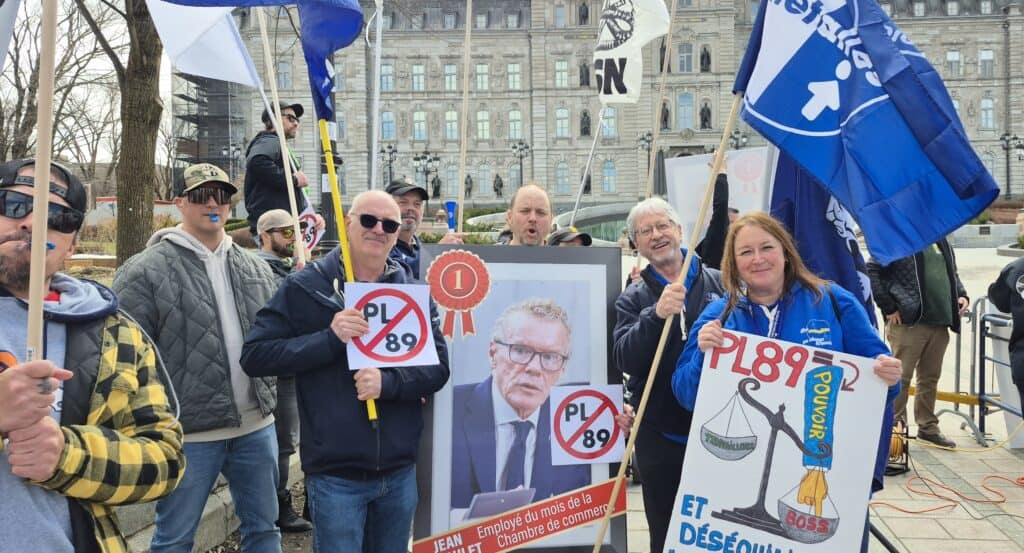
Bashing unions appears to have become fashionable lately in Quebec. The Premier is now floating the idea of restricting political activism by unions. This follows his government’s anti-union legislation (Bill 89), enacted in June, which aims to restrict the right to strike and which will likely be invalidated by the courts for violating Charter rights.
The Premier’s game is clear: to divert attention from the SAAQ and Northvolt scandals and his government’s austerity measures that have cast a pall over the start of the school year.
Social and political action
Conservative groups and the business community are uncomfortable with union activism. The most extreme groups go so far as challenging the validity of the Rand formula, whose principle of fairness ensures that all workers who benefit from a union are required to contribute to it, and in return, unions are required to represent them.
Weakening unions also weakens and drags down all workers, whether they are unionized or not.
Restricting unions to simply the role of negotiating collective agreements ignores the fact that government decisions directly affect the lives of workers. The health and safety laws and regulations that we have today, which have reduced workplace deaths and injuries, were won through the hard-fought political battles of unions.
It is our members’ dues that fund our rallies and protests and our political lobbying to demand greater safety measures for road traffic control workers in order to end the rash of deaths in this sector.
It is our members’ dues that also supported 30 of our union’s grassroots activists who spent six weeks on Parliament Hill lobbying politicians to finally pass legislation to better protect pensioners in the event of corporate bankruptcies – a struggle that we won.
It was our members’ dues that also funded our relentless campaign that led to a law in Quebec than prohibits two-tier pension and benefit plans – legislation that benefits all young workers.
Our political activism includes our calls for industrial and economic policies to secure the future of our forestry sector, to protect good jobs, to increase the minimum wage, etc. This is political action that benefits all workers, not just our members.
When the Steelworkers added our voice, and above all, our resources, to the demands of environmental groups for a new deposit and recycling system for glass beverage containers, the campaign finally came to fruition.
Union activism includes environmental activism, including our involvement at the COP climate change conferences and elsewhere, to ensure that the voices of workers are heard.
Confronted by bosses and deep-pocketed multinationals and their powerful lobbies, it is vital for workers to pool their resources and speak out through their unions.
Workers are not robots.
Our mission is to build and defend a society where every worker can live a decent life, return home to their families at the end of the work day safe and healthy, and be protected from injustice.
Workers are also concerned about decent daycare, schools, health care, pharmacare, housing, the cost of groceries and their retirement security. They logically expect their unions to fight for these services and issues.
As for union finances, financial statements are available to members, and expenditures are approved at general meetings, as are policy directions. Unions also are subject to auditing processes.
Countervailing powers are disruptive
Let’s not forget that when the labour movement is weakened, inequality explodes. This is precisely what has happened in the United States in recent decades, and at an accelerated pace since Donald Trump’s election. It’s unacceptable for Quebec to go down this path.
Unions are disruptive. That is the nature of countervailing powers. The countervailing power of the labour movement is essential to the checks and balances needed in a democratic society.
Nicolas Lapierre
Quebec Director
United Steelworkers
Share on Facebook