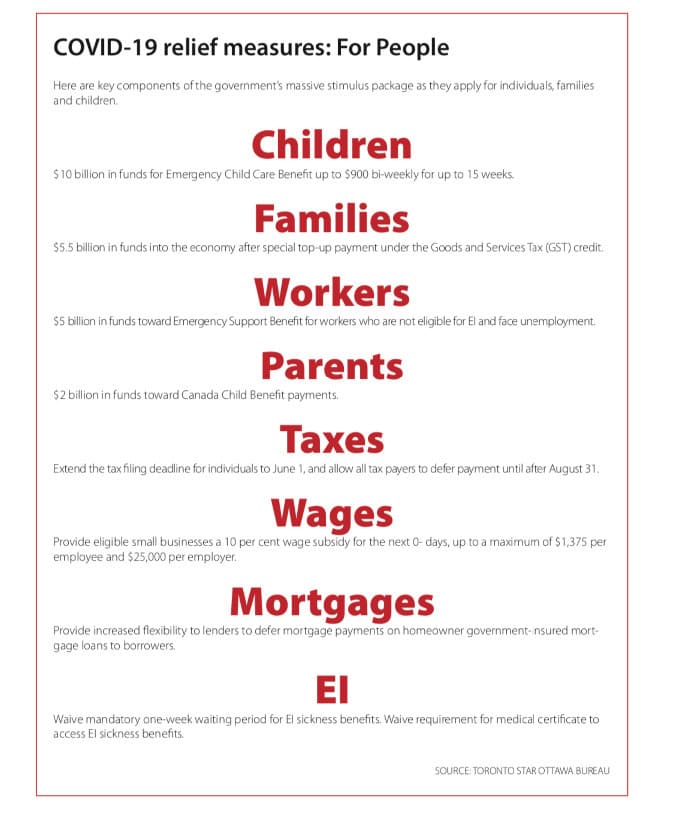
On March 18, 2020, Prime Minister Justin Trudeau announced additional measures to combat the effects of the COVID-19 pandemic:
$27 billion in direct support to workers and businesses
$55 billion in tax deferrals to meet liquidity needs of Canadian businesses and individuals
$82 billion combined, more than 3% of Canada’s GDP
Below is an overview of the programs.
1. Employment Insurance (EI) Sickness Benefits
This program was announced on March 11 and in effect as of March 15. The one-week waiting period and the requirement for medical certificate are temporarily waived. This applies to individuals who have contracted COVID-19 or have been ordered into self-isolation, or must care for someone who has been ordered into self-isolation. The recipient must have worked 600 hours over the previous 52 weeks.
2. Emergency Care Benefit
This is a new program to provide benefits like the EI sickness benefit for people who have not been laid off, but have had their incomes disrupted and do not have access to employer sick leave. It will also apply to workers who are caring for sick family or children that require supervision due to school closures.
This program will be administered through the Canada Revenue Agency (CRA). It is a flat payment of $450/week for up to 15 weeks (prior income does not matter). This is intended as a benefit for people who are not eligible for regular EI or sickness benefits. Workers must first apply for EI (regular or sickness) and if they are denied, they can receive the Emergency Care Benefit. This benefit applies to anyone who is ill, who is self-isolating or needs to take time off because of school closure. The application will be available in April. Legislation is still needed to bring this into force.
3. Emergency Support Benefit
Few details were announced on March 18, however, the point of this benefit is that anyone who is unemployed and not eligible for EI should receive some sort of EI-like benefit. This benefit will also be administered through the CRA. It is likely that people will have to apply to EI first and if they are denied, they could be eligible for this. It is unclear if this will be a replacement rate (e.g., 55% of earnings) or a flat rate, like the 2003 response to SARS for health-care workers. This benefit also needs new legislation before it can be activated.
4. Work Sharing Expansion
The potential length of the EI work-sharing program doubled to 76 weeks from a previous maximum of 38 weeks. The eligibility requirement and the application process will be eased (previously announced on March 11).
online pharmacy buy antabuse with best prices today in the USA
5. GST Credit Boost
Every three months, low- and moderate-income Canadians receive a GST tax credit. In May, (probably) the credit will be boosted by a one-time payment at most of $300/adult and $150/child. Those are the normal amounts for the year so it’s actually a doubling of the GST credit for the year in one shot.
6. Canada Child Benefit
This is a one-time boost to the Canada Child Benefit in May 2020, to at most $300 per child.
7. 10% Wage Supplement for Small Business
Quoting from the Department of Finance: “To support businesses that are facing revenue losses and to help prevent layoffs, the government is proposing to provide eligible small employers a temporary wage subsidy for a period of three months. The subsidy will be equal to 10% of remuneration paid during that period, up to a maximum subsidy of $1,375 per employee and $25,000 per employer.”
8. Support for Vulnerable Communities
New funds will be available for women’s shelters, homeless shelters and Indigenous communities.
9. $55 Billion in Deferred Corporate Taxes and Income Tax
From the Canadian Centre for Policy Alternatives Senior Economist David McDonald: “This is mostly a remittance holiday allowing employers to avoid sending in a portion of the source deduction they take off of each employee’s pay cheque. They’ll no doubt also defer their own corporate income taxes over that period, but it will be a smaller part of the $55 billion.
“I’m not generally in favour of massive corporate support, but in an era where speed trumps perfect policy design, this isn’t the worst measure to keep major businesses from going under. They’ll still have to pay their taxes and remit their employees’ source deductions, just six months from now. The danger is that six months from now, businesses will argue they shouldn’t have to pay them at all.”
For more information and resources for workers, see our USW page on COVID-19: www.usw.ca/covid19.
Tomorrow is Election Day in British Columbia and there’s too much at stake for Steelworkers to sit this one out. Across our province, working families are facing real challenges. Forestry communities are fighting to protect jobs and keep mills running. Mining workers need stronger safety protections and training. Canadian jobs are threatened by outsourcing, and […]
KAMLOOPS, B.C. – United Steelworkers union (USW) Local 7619 has issued 72-hour strike notice to Teck’s Highland Valley Copper (HVC) operation near Logan Lake, B.C., following unsuccessful negotiations to reach a fair collective agreement. The notice was served Tuesday, Oct. 20, at 6:30 p.m., with the union preparing for potential strike action if an agreement […]
The jobs of thousands of USW members have been plunged into uncertainty due to U.S. tariffs, outsourcing and offshoring. In 2025, the Steelworkers Humanity Fund (SHF) has supported initiatives that help build union-to-union solidarity, which is critical to ensuring workers have a voice. Over the years, the USW has supported the efforts of the Mexican […]