Kingston, ON – If you’ve never been underground – really, really underground – then you can’t imagine the darkness. It’s like none you’ve experienced. It’s thick; it seems to actually fill your ears, nostrils and mouth, as though it were sand, or worse, water.
You’d swear you’re choking on darkness itself.
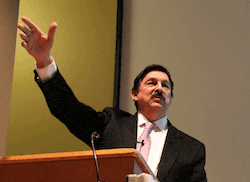
Mexican labour leader Napoleón Gómez knows this darkness well. But he knows another kind of darkness too. As Gómez explained to an enthusiastic audience at Queen’s University Wednesday night, he’s all-too familiar with the shroud of darkness that covers warm relations between corporations and corrupt governments in Mexico.
After an explosion tore through the main vertical shaft at the Pasta de Conchos coal mine in Northern Mexico, trapping 65 miners some 500 metres underground, Gómez found himself trying to shed light on the disaster’s true causes.
But this has proven a monumental task, even for a man accustomed to fighting Mexico’s corrupt political landscape. Shockingly, the mine’s owner, Grupo Mexico, suspended rescue operations less than five days after the explosion, claiming there was no chance the miners had survived the explosion itself, let alone the ensuing period of oxygen deprivation.
Gómez has never bought it for a moment. He explained to his audience that the two bodies searchers did find bore no burns; and, the mine’s ventilation system was still operating properly after the explosion. To him, scant evidence upheld speculation that the miners were already dead, either by explosion or oxygen deprivation.
Certainly not enough to justify suspension of rescue efforts so prematurely.
The unalloyed truth, Gómez insists, is that neither the mine’s owners nor government officials actually wanted the men found. Human bodies (dead or alive) can tell tales. In the case of Pasta de Conchos, those tales would be of an atrocious (well documented) safety record resulting in a hazardous, indeed, explosive workplace.
By Gómez’s reckoning, recovering the miners’ bodies would have been tantamount to an admission of “industrial homicide,” a term the exiled leader uses unequivocally to describe Grupo Mexico’s actions.
These are serious charges to level against a massive company in a country where the revolving door between corporate powerbrokers and corruptible government legislators spins like a top. So it’s little wonder that death threats flooded in, leaving Gómez no choice but to flee Mexico for Vancouver with his wife, Oralia, and his three sons to follow.
Gómez’s story inspired United Steelworkers Local 2010 President, Kelly Orser Smith, so much that she felt she had to invite the union leader to Kingston to address members of the Queen’s community.
“Workers are so fortunate in so many ways here in Canada,” Orser Smith explained, “but it’s important to remember always that the status of labour can change quickly… can deteriorate, especially in an era that places so much faith in business leaders and a so-called ‘sound business climate.'”
“Mr. Gómez carries a cautionary tale we ignore at our peril” Orser Smith added.
It seems her union’s director agrees when it comes to Napoleón Gómez. Ken Neumann, USW National Director, also in attendance, referred to Gomez as “that one person [who] summon[ed] the courage to become a hero,” to stand up and say “no more.”
Slowly but surely, Gómez is being vindicated. Canadian officials refused even to consider any extradition order because, apparently, it’s assumed that any such request by Mexico would be based on trumped-up charges.
And, in the wake of the 2010 Copiapo mine collapse in Chile, Bishop Raul Vera demanded that the case of Pasta de Conchos be reopened. The Chilean case, in which 33 miners survived sixty-nine days at a depth of 700 metres, had striking parallels with the Mexican case.
Except for the survivors.
Sadly, the very strategy that worked to save Chilean miners (boreholes dug alongside the mine’s main shaft) was urged, but ruled out by Grupo Mexico.
And that was that.
All of which is terribly sad, because dozens of families were thereby suspended in their own kind of darkness, which only their dead relatives, entombed 500 metres beneath the Mexican sun, could possibly have appreciated.
Share on Facebook